Install Conky On Mac Os X
It doesn't look like there's a Conky port on OS X, or if there is, I'm not. What are some of the system monitoring favorites here in the Mac Ach?
Conky is a system monitor application written in ‘C’ Programming Language and released under GNU General Public License and BSD License. It is available for Linux and BSD Operating System. The application is X (GUI) based that was originally forked from Torsmo.
Features
- Simple User Interface
- Higher Degree of configuration
- It can show System stats using built-in objects (300+) as well as external scripts either on the desktop or in it’s own container.
- Low on Resource Utilization
- Shows system stats for a wide range of system variables which includes but not restricted to CPU, memory, swap, Temperature, Processes, Disk, Network, Battery, email, System messages, Music player, weather, breaking news, updates and blah.blah.blah
- Available in Default installation of OS like CrunchBang Linux and Pinguy OS.
Lesser Known Facts about Conky
- The Name conky was derived from a Canadian Television Show.
- It has already been ported to Nokia N900.
- It is no more maintained officially.
Conky Installation and Usage in Linux
Before we install conky, we need to install packages like lm-sensors, curl and hddtemp using following command.
Time to detect-sensors. Belajar membaca anak tk gratis.
Note: Answer ‘Yes‘ when prompted!
Check all the detected sensors.
Sample Output
Conky can be installed from repo as well as, can be compiled from source.
Note: Before you install conky on Fedora/CentOS, you must have enabled EPEL repository.
After conky has been installed, just issue following command to start it.
It will run conky in a popup like window. It uses the basic conky configuration file located at /etc/conky/conky.conf.
You may need to integrate conky with the desktop and won’t like a popup like window every-time. Here is what you need to do
Copy the configuration file /etc/conky/conky.conf to your home directory and rename it as ‘.conkyrc‘. The dot (.) at the beginning ensures that the configuration file is hidden.
Now restart conky to take new changes.
Conky Monitor Window
You may edit the conky configuration file located in your home dircetory. The configuration file is very easy to understand.
Here is a sample configuration of conky.
From the above window you can modify color, borders, size, scale, background, alignment and several other properties. By setting different alignments to different conky window, we can run more than one conky script at a time.
Using script other than the default for conky and where to find it?
You may write your own conky script or use one that is available over Internet. We don’t suggest you to use any script you find on the web which can be potentially dangerous unless you know what you are doing. However a few famous threads and pages have conky script that you can trust as mentioned below.
http://ubuntuforums.org/showthread.php?t=281865
http://conky.sourceforge.net/screenshots.html
At the above url, you will find every screenshot has a hyperlink, which will redirects to script file.
Testing Conky Script
Here I will be running a third party written conky-script on my Debian Jessie Machine, to test.
Change current working directory to just extracted directory.
Rename the secrets.yml.example to secrets.yml.
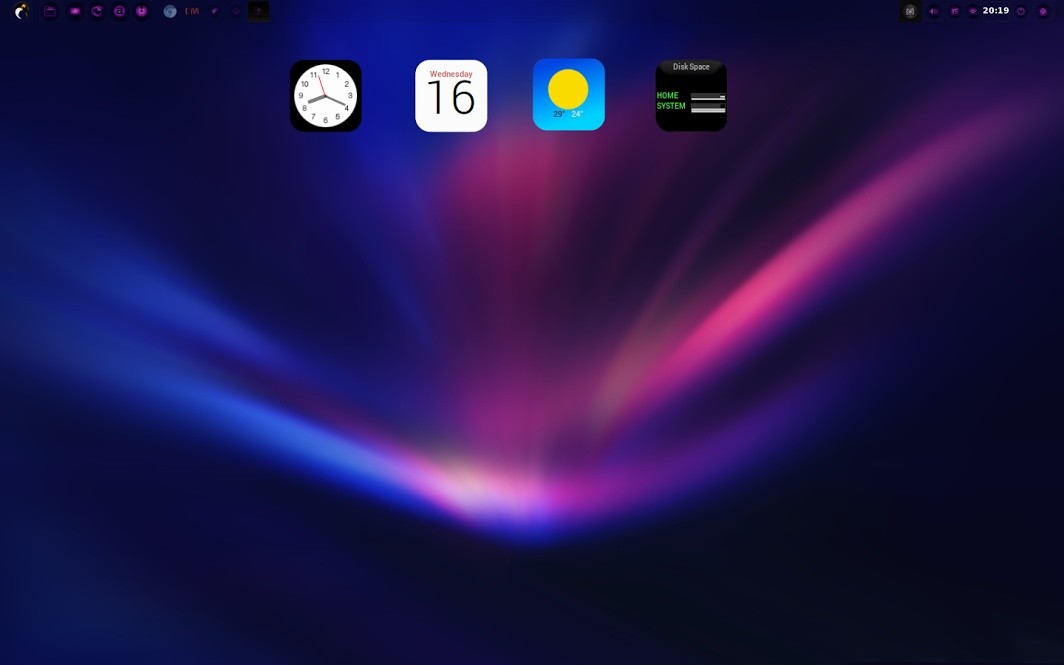
Install Ruby before you could run this (ruby) script.

Conky Fancy Look
Note: This script can be modified to show your current weather, temperature, etc.
If you want to start conky at boot, add the below one liner to startup Applications.
And Finally…such a lightweight and useful GUI eye candy like package is not in active stage and is not maintained officially anymore. The last stable release was conky 1.9.0 released on May 03, 2012. A thread on Ubuntu forum has gone over 2k pages of users sharing configuration. (link to forum : http://ubuntuforums.org/showthread.php?t=281865/)
That’s all for now. Keep connected. Keep commenting. Share your thoughts and configuration in comments below.
Most of the time you'll never have to worry about having to install a new operating system on your Mac - the one that's on there should work fine through thick and thin. But every once in a while you might want or need to - here are step by step instructions for making it happen.
Install Conky Manager
Use Recovery Mode
Every Mac operating system since Lion (OS X 10.7) has included Recovery Mode, a special boot partition that enables you to recover from catastrophic failures and problems. This can be used to install a fresh copy of Mavericks on your hard drive, provided you have Internet access. To use Recovery Mode, follow these instructions:
- Shut down your Mac.
- Press the Power button (the button marked with a O with a 1 through it)
- Immediately press the command (cloverleaf) key and R together.
- Make sure you're connected to the internet through Wi-Fi. If you're not, choose a network from the Wi-Fi menu that appears at the top-right corner of the screen.
- Select Install Mac OS X, then click Continue.
- Wait.
It's worth noting that this installs a fresh copy of OS X on your Mac without affecting either your files or your user settings, so you should be good to go as soon as it reboots. All applications are maintained, as well. This system simply replaces the core files that enable OS X to operate.
I've had occasion to see systems that don't work with Recovery Mode, for some reason. For those computers, it's often possible to restore access to the Recovery Mode partition by resetting the System Management Controller (SMC). To reset the SMC on most Macs:
- Shut down the Mac. If it's a laptop, make sure it's connected to the power cord.
- Hold down the Control, Option, and Left Shift keys simultaneously, then press the Power button.
- Release the keys.
- Press the Power button again. The system should turn on and you can give Recovery Mode another try.
If that fails to work, you can always download a fresh copy of the Mavericks installer from the Mac App Store.
Download a fresh copy of Mavericks from the Mac App Store
- Open the Mac App Store application, either from your Dock or from the Applications folder.
- Click on the Purchases tab at the top of the window or press command and 4 on your keyboard. (I'll assume for the moment that you have already installed Mavericks once - if you haven't, you should see an installation option in your Updates folder, assuming you have Snow Leopard or later installed.)
- Find OS X Mavericks in the list of files, either scrolling through the list or using the Search field in the upper right hand corner of the window.
- Click the Download button.
- You may get a dialog box advising you that OS X 10.9 is already installed on this computer. It's safe to click the Continue button.
- Be prepared to wait a while. Even over a fast Internet connection, it'll take a little while to download, since it's more than 5 GB.
- Once it's downloaded, it'll launch automatically. Follow the directions to install OS X.
Hopefully this will help you get started if you need to install a fresh copy of Mavericks. Questions? Fire away in the comments.